


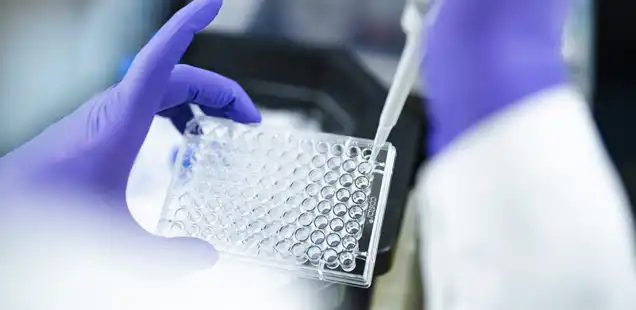
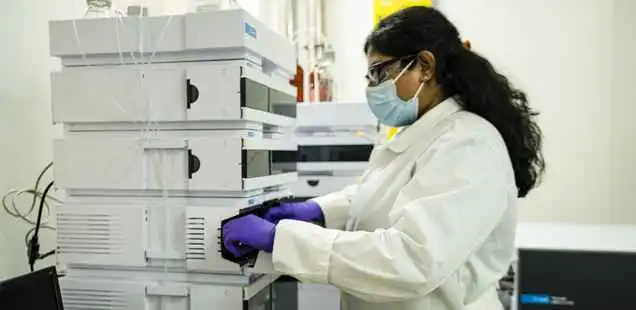
In vitro assays play a pivotal role in de-risking ADC development by evaluating the functional efficacy, specificity, internalization, and cytotoxic potential of antibody-drug conjugates. At Aurigene, our in vitro bioassay platform is designed to provide rapid, reliable, and mechanism-relevant insights into how your ADC behaves in a cellular context. We offer target-based, cell-based, and mechanistic assays to help characterize the biological performance of ADCs prior to advancing into in vivo studies. Our team works closely with you to customize assay design based on your antibody, payload mechanism, and cancer indication of interest.
We support both standardized panels and custom assays, using validated protocols and well-characterized cell lines that match your ADC's target expression profile.
Cytotoxicity Assays (Cell Viability)
- Performed across target-positive and negative cell lines
- Quantification of IC₅₀ values
- Multiple platforms: MTT, CellTiter-Glo
Primary readout for potency and target-dependent killing
Target Expression Profiling
- Flow cytometry and western blotting to validate target antigen expression across panel of cell lines
Ensures optimal cell line selection for screening and comparators
Internalization Assays
- Flow cytometry using fluorescent-labeled antibodies or ADCs
- Time-course evaluation of ADC uptake
Confirms receptor-mediated internalization key to ADC mechanism
Receptor Binding Affinity Assays
- Surface Plasmon Resonance (SPR), Biolayer Interferometry (BLI), or flow-based binding assays
Evaluates impact of conjugation on antibody-target interaction
Bystander Killing Effect (if applicable)
- Co-culture assays using target-negative cells in presence of target-positive cells
Validates ability of membrane-permeable payloads to induce bystander cytotoxicity
Why choose Aurigene?
At Aurigene, we combine biological insight with rigorous execution to ensure your in vitro assay data is meaningful, reproducible, and aligned with clinical relevance. Our deep expertise in ADC biology, including a strong understanding of payload class, target biology, and resistance mechanisms helps us design assays that mirror real-world tumor behavior.
We offer:

Wide panel of validated human cancer cell lines

Expertise in working with diverse payloads (MMAE, MMAF, DXd, SN38, Exatecan, PNU, etc.)

Custom assay development tailored to your ADC mechanism

Flexible assay formats (96-well, real-time cytotoxicity)

Integrated support from conjugation through efficacy evaluation
Whether you are characterizing early leads or performing comparative potency for clinical candidates, Aurigene’s in vitro team delivers high-quality data that drives fast decisions making.
Virtual Tour

Hyderabad R and D Center

Bangalore R and D Center
Connect with our scientific experts for your drug discovery, development, and manufacturing needs
We understand that clear communication is essential to successful collaborations, and that's why we have a dedicated team that is always ready to help you. Whether you have questions about our services, want to discuss a potential partnership, or simply want to learn more about our company, we're here to help.
Our team of experts is dedicated to providing personalised solutions tailored to your unique needs. So, please don't hesitate to reach out to us. We look forward to hearing from you and helping you achieve your business goals.
Resources
JULY 02, 2026
The Journey from Scientific to patient impact
Home › Company › Aurigene 360°: The Journey from Scientific Insight to Patient Impact Publish on : January 25, 2026 Shares: Every medicine begins with a question. Sometimes with a scientist studying a protein structure late at night. Sometimes with a disease that still has no effective treatment. Sometimes with a ...
Read More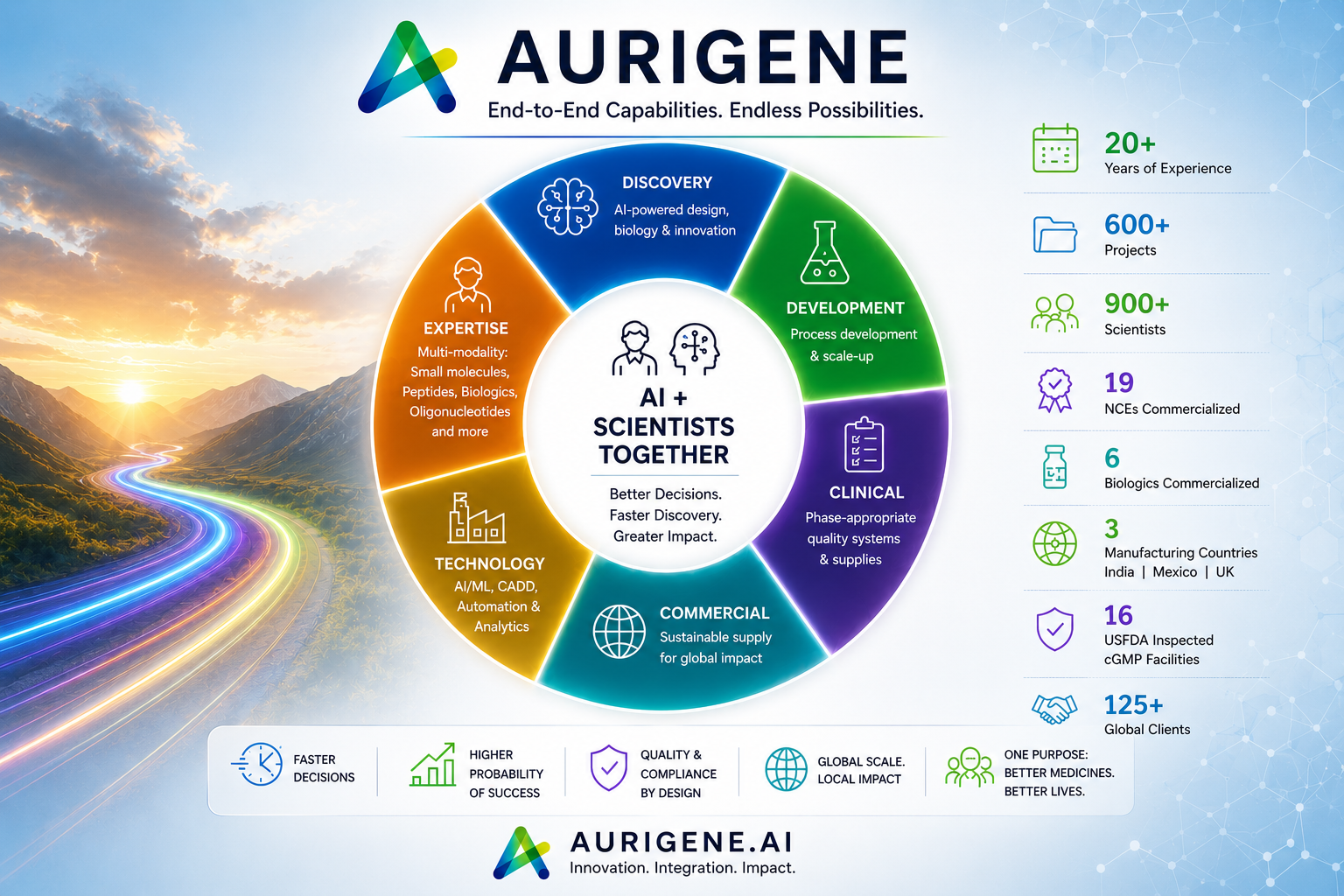
Advancement in personalized medicine and how the CRDMO industry is part of the solution
Personalized medicine is transforming the healthcare landscape by customizing treatment plans to individual patients’ unique genetic, clinical and environmental characteristics. These are effective and less invasive treatments for a wide range of conditions. Contract Research, Development and Manufacturing Organizations (CRDMOs) play an important role...
Read More
Cell Line Development
We enable development of stable and high yielding recombinant Mammalian and Microbial lines. ...
Read More
Identification of Degradants of Thermal and Oxidation Stress Studies of Empagliflozin and Linagliptin Tablets by HPLC-PDA and LC-MS Instrumental Techniques
2022
Objective of the manuscript is to identify the degradants observed in the thermal and oxidation degradation sample of Empagliflozin and Linagliptin tablets by using LC-MS and HPLC-PDA instrumental techniques. Thermal and oxidation degradation samples were injected in HPLC-PDA and LC-MS instruments. Mass of the degradants were detected by LC-MS technique, ...
Read More-
Discovery of MAP855, an Efficacious and Selective MEK1/2 Inhibitor with an ATP-Competitive Mode of Action.
2005
Mutations in MEK1/2 have been described as a resistance mechanism to BRAF/MEK inhibitor treatment. We report the discovery of a novel ATP-competitive MEK1/2 inhibitor with efficacy in wildtype (WT) and mutant MEK12 models. Starting from a HTS hit, we obtained selective, cellularly active ...
Read More -
Wang-OSO3H catalyzed green synthesis of bioactive isoindolo[2,1- a ]quinazoline-5,11–dione derivatives: An unexpected observation
2005
The sulphonic acid-functionalized Wang resin (Wang-OSO3H) was explored as a polymeric and recov- erable acidic catalyst for the synthesis of isoindolo[2,1- a ]quinazoline-5,11–dione derivatives under green conditions. Thus the Wang-OSO3H ...
Read More -
Polycyclic Aromatic Compounds: A Simple and Efficient [(n-Bu3Sn)2MO4]n Catalyzed Synthesis of Quinazolinones and Dihydroquinazolinones
2005
A novel unprecedented approach for the synthesis of various quinazolinones and dihydroquinazolinones has been using [(n-Bu3Sn)2MO4]n as a catalyst. The reaction has been screened ...
Read More
You are about to leave Aurigene Pharmaceutical Services and affiliates website. Aurigene Pharmaceutical Services assumes no responsibility for the information presented on the external website or any further links from such sites. These links are presented to you only as a convenience, and the inclusion of any link does not imply endorsement by Aurigene Pharmaceutical Services.
If you wish to continue to this external website, click Proceed.


Leaving already?
Don't forget to join us at
CPHI Worldwide 2023.
October 24th-26th, 2023 | Barcelona, Spain
Get ready to accelerate your drug’s journey to the market