


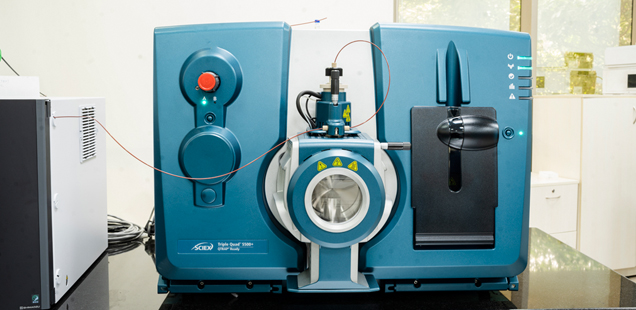
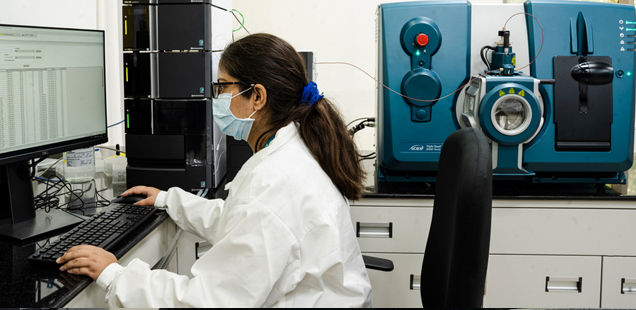
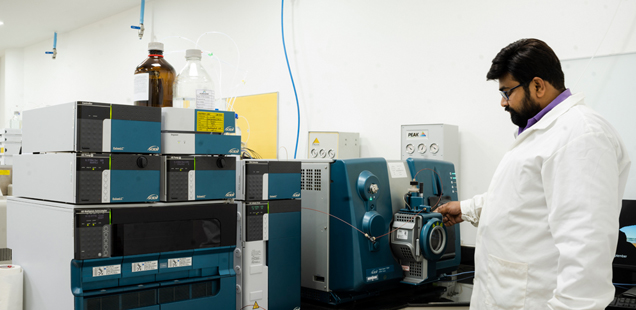
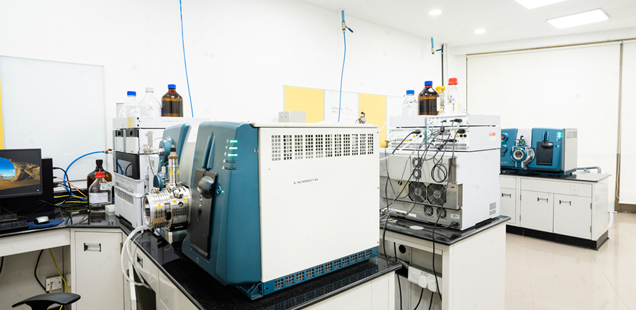
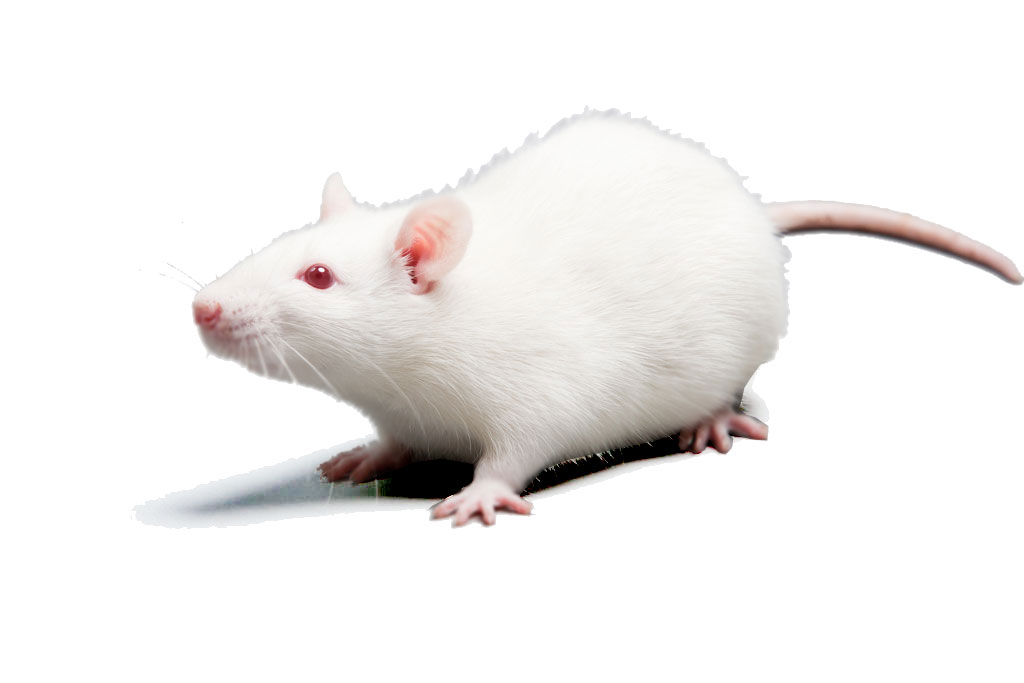
Aurigene offers GLP & Non-GLP bioanalysis services for small molecules, peptides, biomarkers and complex molecules. Our Bioanalytical labs are well-equipped with high-end LC-MS/MS instruments, HPLCs/UPLCs with UV, PDA and fluorescence detectors. We have completed more than 200 GLP studies. We perform sample analysis of GLP PK/TK/ TD studies. We do method validation as per regulatory requirement and ensure data quality and compliance.

Why Aurigene Pharmaceutical Services?

Delivered 200+ GLP studies

Compound management and data automation

Quality and Accuracy
Regulatory submissions to US FDA, EMA, DGCI
Virtual Tour
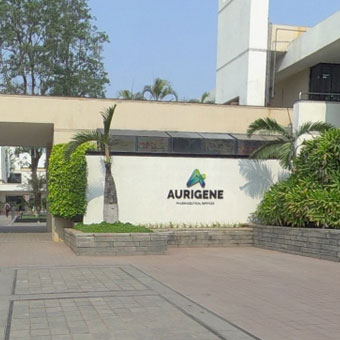

Hyderabad R and D Center

Bangalore R and D Center
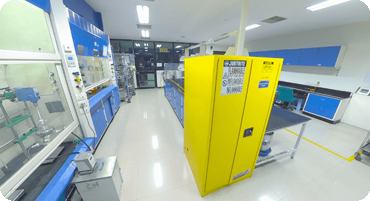
Polymorph Screening
Connect with our scientific experts for your drug discovery, development, and manufacturing needs
We understand that clear communication is essential to successful collaborations, and that's why we have a dedicated team that is always ready to help you. Whether you have questions about our services, want to discuss a potential partnership, or simply want to learn more about our company, we're here to help.
Our team of experts is dedicated to providing personalised solutions tailored to your unique needs. So, please don't hesitate to reach out to us. We look forward to hearing from you and helping you achieve your business goals.
Resources
Accelerating Drug Discovery Through Innovative Partnerships
Accelerating Drug Discovery Through Innovative Partnerships Genomics plays a vital role in identifying which gene is associated with a specific disease. A gene called CNOT1 is for example known for it's effect on brain development and for impairing memory and learning. Despite the great promise genomics provides in understanding the disease, gene...
Read More
Methoxy Polyethylene Glycol (m-PEGs)
Aurigene Pharmaceutical Services is a leader in the synthesis of activated MethoxyPolyethyleneGlycol(m-PEGs), With a comprehensive product range and customized services. ...
Read More
Base mediated spirocyclization of quinazoline: one-step synthesis of spiro-isoindolinone dihydroquinazolinones
2020
A novel approach for the spiro-isoindolinone dihydroquinazolinones has been demonstrated from 2- aminobenzamide and 2-cyanomethyl benzoate in the presence of KHMDS as a base to get moderate yields. The reaction has been screened in various bases followed by solvents and a gram scale reaction has also been executed under the given conditions. Based on the controll...
Read More-
Ultrasound assisted rapid synthesis of mefenamic acid based indole derivatives under ligand free Cu-catalysis: Their pharmacological evaluation
2005
An improved and rapid synthesis of mefenamic acid based indole derivatives has been achieved via the ligand free Cu-catalyzed coupling-cyclization method under ultrasound irradiation. This simple, straightforward and inexpensive one-pot method involved the reaction of a terminal alkyne derived from mefenamic acid with 2- iodosulfanilides in the presence of CuI ...
Read More -
Formal synthesis of Cladospolide C & epi-Cladospolide C using R- (þ)-g-valerolactone as a chiral synthon
2005
The formal synthesis of Cladospolide-C and its analog is achieved by using enantiopure (R)-g evalerolactone 10. The significant points of this synthesis are the stereoselective dihydroxylation of a, bunsaturated ester 16 using Sharpless protocol, Wittig olefination of g evalerolactol 6 with triphenylphosphonium iodide salt 7, one pot selective oxidation ...
Read More -
Amberlite-15 promoted an unprecedented aza Michael rearrangement for one pot synthesis of dihydroquinazolinone compounds
2005
A new one pot multicomponent annulation strategy for the synthesis of various dihydroquinazolinone compounds has been developed using Amberlite-15 as a catalyst, giving good to moderate yields. In this reaction the substrate scope for amines and aldehydes was also investigated. The reaction has been checked on a large scale ...
Read More
Frequently asked questions
What is pharmaceutical development?
Pharmaceutical development identifies and evaluates processes required to convert an NCE/drug substance into a drug product to deliver for its intended performance/purpose consistently. The pharmaceutical development process begins by measuring drug substance properties, identifying critical attributes of the drug product, checking absorption and stability profile of the drug, and the most appropriate route of administration (e.g. oral, parenteral, or topical).
Why is pharmaceutical development important at early drug development stage?
Pharmaceutical development evaluation already at the early drug development stage is essential for selecting the right NCE and formulation to reduce the attrition rate in the late-stage development. These activities streamline efficacy/toxicology evaluations, allowing pharmacologically effective and developable molecules to reach the clinic and eventually patients.
What are the advantages of integrated early-stage drug development?
The integration and close collaboration of preclinical and clinical development teams accelerate the FIH product development process by utilizing already available pre-formulation and bioavailability information and experience gained during preclinical formulation development. It also helps identify obstacles and apply the right formulation strategies early in the drug development process to avoid costly late-stage failures, significantly saving time and costs.
What is bioavailability?
The rate and extent to which the active ingredient or active moiety is absorbed from a drug product and becomes available at the biological system site.
What factors affect bioavailability?
The movement of the drug in the biological system is influenced by many factors such as routes of administration, physicochemical drug properties, physiological factors (e.g. gastrointestinal pH, gastric emptying, small intestinal transit time, bile salt, absorption mechanism, food, metabolism), manufacturing technique, dosage form, and excipients. Understanding the interrelationship of these factors leads to biopharmaceutical and science-based drug product developments.
Why is the oral bioavailability of drugs less than 100%?
Incomplete oral absorption could be due to poor solubility, poor intestinal permeability, or presystemic metabolism. Incomplete oral bioavailability can often be surmounted through formulation efforts.
How do you increase oral bioavailability?
We can enhance the oral bioavailability through formulation efforts using solubilizers, pH adjustment, cosolvents, complexing agents, permeation enhancers, and enabling technologies (solid dispersion, particle size reduction and lipid-based drug delivery systems).
br>By identifying potential limiting steps for oral absorption of a compound (including dissolution, solubility, permeability, and limited metabolism process), understanding the physicochemical properties of a compound, recognizing physiological processes affecting drug absorption, along with awareness of a drug's BCS and DCS characteristics, pharmaceutical scientist can better predict formulation approaches that can maximize the drug’s bioavailability.
Why is formulation development required at the preclinical drug development stage?
Formulations play a crucial role in assessing the biological properties of a molecule during drug discovery. Maximizing exposure is the primary objective of early animal experimentation to avoid discarding developable compounds with the desired pharmacologic properties.
Diversity in the physiology between various animal species, routes of administration, limited compound amount, and limitations posed by specific pharmacological models make formulation development much more challenging. Consistency in the exposure is also a key aspect as significant variations are observed in early NCE batches.
Additionally, preclinical tox (GLP) studies at early development, require NCE formulations that are simple, robust, provide ease of preparation, convenient to deliver to animals with minimal ancillary effects of vehicle and provide provision of high and dose-related systemic exposures in animals relative to anticipated human exposures to facilitate determination of tox profiles.
The selection and development of effective formulation and drug delivery strategies are essential to achieve this.
You are about to leave Aurigene Pharmaceutical Services and affiliates website. Aurigene Pharmaceutical Services assumes no responsibility for the information presented on the external website or any further links from such sites. These links are presented to you only as a convenience, and the inclusion of any link does not imply endorsement by Aurigene Pharmaceutical Services.
If you wish to continue to this external website, click Proceed.


Leaving already?
Don't forget to join us at
CPHI Worldwide 2023.
October 24th-26th, 2023 | Barcelona, Spain
Get ready to accelerate your drug’s journey to the market